This blog examines issues concerning Steve Elmore's book "In Search of Nampeyo: The Early Years, 1875 - 1892" and Harvard's lawsuit against it.
Showing posts with label intellectual property. Show all posts
Sunday, May 22, 2016
HARVARD LOSES COPYRIGHT INFRINGEMENT CASE AGAINST STEVE ELMORE
Note: This case is still ongoing. Harvard's copyright infringement charges were the subject of motions for partial summary judgements, and the judge ruled against them as discussed in detail below. However, Harvard's breach of contract claim against Mr. Elmore is still open and will be discussed in the next two blog entries.
The first entry in the Free Nampeyo blog discussed Harvard's copyright infringement claims against Steve Elmore's book In Search of Nampeyo: The Early Years 1875 - 1892. You can read Why is Harvard Claiming Copyright to Native American Designs? for more background.
The subject of Harvard's complaint was whether color illustrations of designs on old Hopi pottery held in the Keam collection at Harvard's Peabody Museum violated the copyright to their black and white photographs of this pottery. Mr. Elmore filed a motion for partial summary judgement against this claim, asking the judge to consider the law and the facts and make a ruling. Harvard also filed a cross-motion for partial summary judgement concerning a photograph of a Kayenta or Tusayan jar that appeared on its website and also in Mr. Elmore's book. Both claims were decided by Judge Robert C. Brack of the United States District Court in Las Cruces, New Mexico. Judge Brack's ruling "Grants Defendant's Motion for Partial Summary Judgement (Doc.92); and Denies Plaintiff's Cross-Motion for Partial Summary Judgement that Elmore is liable for Copyright Infringement (Doc. 109). " His whole opinion is linked at the end of this post.
Determining whether copyright infringement has occurred can be a complex matter. The decision depends on two basic factors. The first is whether the underlying work is copyrightable at all and, if so, which elements of the work are subject to copyright. The second is whether the work accused of infringing on the protected aspects of the underlying work in fact does infringe. The present Opinion is a good example of sorting out the fine points of such a case, thus the rest of this essay will look at the details of Judge Brack's decision.
Below is the photograph of the Kayenta or Tusayan jar that was the subject of Harvard's cross-motion for partial summary judgement. Judge Brack's Opinion is that this is not a copyrightable photograph.
Quoting from the Compendium of U. S. Copyright Practices, third edition "as with all copyrighted works, a photograph must have a sufficient amount of creative expression to be eligible for registration". A photograph should not be registered "if it is clear that the photographer merely used the camera to copy the source work without adding any creative expression to the photo". Judge Brack argues that this photograph is just such a case. It was not taken as a study in photography or crafted by the photographer with carefully chosen lighting and background, but rather was a "conservation image" taken as part of a "condition assessment" while the jar rested on a surface with a bunch of other stuff visible behind it.
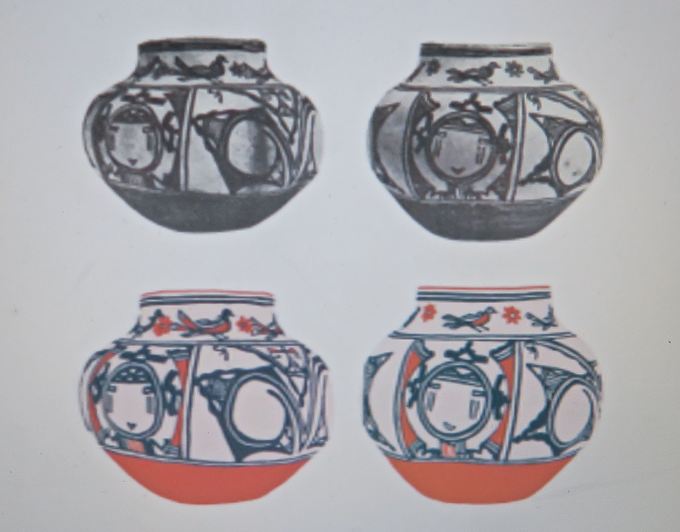
The second part of the Opinion is more complex. It involves 41 illustrations created from designs visible in the black and white photographs of pottery that were published in the book Historic Hopi Ceramics (HHC). Below is a comparison of two of the black and white photographs and the illustrations created from them.
First Judge Brack determined that, unlike the photograph of the Tusayan or Kayenta jar discussed above that is not copyrightable, the black and white photographs in HHC show "a minimal degree of creativity--if only a humble spark". Decisions were made to photograph each ceramic in the same way and to strip the backgrounds from each of the individual photographs "to emphasize the impact of the collection as a whole rather than the intricacies of each individual piece." However, just because a photograph is copyrightable does not mean that "every element of the work is protected....the less original the plaintiff's work, the more the defendant must copy to infringe on the plaintiff's copyright."
Importantly. Judge Brack finds that the Native American designs on the pottery and the form of the pottery are not copyrightable elements of Harvard's photographs: "Here the copyright of Historic Hopi Ceramics does not protect against copying the most prominent features in the works: the intricate pottery designs and forms achieved by a Hopi potter, perhaps Nampeyo." (emphasis added).
Judge Brack notes that the protection of the HHC photographs is "incredibly limited" and only a verbatim copy would violate a copyright with such a small amount of creative input from the photographer. He observes that Mr. Elmore's illustrations highlight the designs, which are non-copyrightable elements, and switch the emphasis from the condition of the pots as a whole collection to these design elements. The illustrations use line art and are in color. They clean up and bring out elements of the designs, while eliminating aspects of the pottery itself, such as fire clouds. Judge Brack writes: "Considering only the protected elements in the Historic Hopi Ceramics photographs and Mr. Elmore's images, reasonable minds could not find substantial similarity between the two."
He also notes that Mr. Elmore picked individual ceramics to use in his illustrations and did his own arrangements of them, in order to emphasize comparison of the designs. Mr. Elmore's use of these ceramics to establish a novel thesis would give his work protection under the fair use doctrine.
I have to wonder why Harvard brought this copyright infringement suit against Mr. Elmore in the first place. His use of illustrations of designs seen in photographs is quite common in ethnology and archaeology publications and is a long standing practice. Illustrations done from photographs of pottery in a museum are used, for instance, in Symbols in Clay, a 2010 publication from the Peabody Museum Press. Why is The Peabody Museum Press at Harvard suing Mr. Elmore for doing the exact same thing that they did in a recent publication? Why didn't the editor, Joan O'Donnell, consider this before pursuing this charge? Why didn't the Peabody Museum Director, Jeff Quilter, point out this obvious fact before a lawsuit was filed? Why didn't Harvard's legal counsel do even the most cursory inquiry about the use of illustrations of pottery designs in publications before filing this suit?
Perhaps some sense of this can be made by looking to Harvard's expert witness report. On page 5 of his disclosure, Thomas Chavez, retired director of the Palace of the Governors in Santa Fe, New Mexico, writes that museums often charge fees for the use of their copyrighted photographs, and indeed, the Peabody Museum at Harvard charges such fees and they constitute one of their revenue streams. It is possible that the Peabody Museum was eager to extend the reach of its copyrights, thus enlarging the number of photographs that could generate income for the museum. It is also possible that this copyright infringement charge was frivolous and/or vindictive in its motives. If this is true, then neither the facts of the case nor the law were important elements in the decision to bring the charges.
Mr. Elmore is grateful that this ruling found him innocent of copyright violation charges and that the Native American designs he used in his book are still freely available to all, but especially to the Hopi/Tewa potters who consider them such an important part of their cultural heritage.
Mr. Elmore would like to thank his attorneys, Christopher DeLara and Jonathan Garcia of the Guebert Bruckner law firm in Albuquerque, New Mexico for their hard work, clear thinking, and fine writing in pleading this matter before the court.
Opinion and Order MSJ
This is the fourth in a series of blogs about In Search of Nampeyo and Harvard's lawsuit against Steve Elmore. Future essays will deal with the contracts and abuse of the legal system.
Creative Commons License BY NC ND
Tuesday, May 10, 2016
A Researcher's Worst Nightmare at Harvard University
Researchers who depend on an ethical process when they submit their work for review may suspect that the process was perverted in some way when their work is rejected, but reviewer anonymity and confidentiality usually prevent the researcher from having access to information necessary to evaluate the process. In the case of Steve Elmore’s book In Search of Nampeyo: The Early Years, 1875-1892 which now is the subject of a lawsuit brought by Harvard, discovery documents give us a glimpse into their process and it is a researcher’s worst nightmare. Harvard is still concealing many relevant documents and has put others under a protective order, so I will only discuss here, and link to, documents that are now in the public record.
For those not familiar with the academic peer review process, generally a work is submitted to a journal or book press and the editor sends it out to two or more professionals for review. Reviewers submit their comments and recommend acceptance, rejection, or acceptance with revisions. If the manuscript is not rejected, the author will be asked to address reviewers’ concerns and make suggested changes or convince the editor that the suggested changes are not warranted. After the revised manuscript is submitted, there are usually a few more exchanges between editor and author, and then the work is ready to go to press.
Editors and reviewers are expected to adhere to ethical standards. For instance, International Standards for Editors that were adopted at the World Conference on Research Integrity in 2010. Among the eight standards listed are “Editors should make fair and unbiased decisions independent from commercial consideration and ensure a fair and appropriate peer review process” and “Editors should adopt editorial policies that encourage maximum transparency and complete, honest reporting”. Peer reviewers also are expected to adhere to ethical standards. Here are the peer reviewer standards issued by the Committee on Publication Ethics. Among the standards are to respect confidentiality, declare potential conflicts of interest, not allow reviews to be influenced by the “origins of a manuscript…by characteristics of the author, or by commercial considerations”, and to “refrain from being hostile or inflammatory and from making libelous or derogatory comments.”
The Peabody Museum Press solicited Steve Elmore to write a book for them on his discovery that many of the modern ceramics in their Keam Collection (purchased from the trader Thomas Keam in 1892) were the work of the great Hopi potter Nampeyo. This discovery was only made possible by Mr. Elmore's 20 years of reading, research in other museums, and working with contemporary Hopi potters. Mr. Elmore's first manuscript was submitted in April 2012. The first reviewer called the editor and they exchanged emails about the manuscript. Notice that ethical guidelines are breached throughout this exchange, and that the reviewer and the editor are full collaborators in these transgressions of ethical standards.
Reviewer #1 attacks Mr. Elmore personally, calling him “not capable of comprehending the differences between collections” and “not prepared to do the required amount of research”. He accuses Mr. Elmore of having ulterior motives, writing the book to promote the pottery he sells, while assuring the editor that dealers who curated exhibits in his museum have no interests in selling their own wares; these guest curators had “no agenda but to give appropriate recognition.” He insults in advance the many other readers of the book who he asserts cannot distinguish between proper analysis and the “eyewash that is presented here”. I would dispute reviewer #1 on his specific claims, but for the purposes of this essay, such ad hominem attacks should be a red flag for any editor seeking an objective assessment of a manuscript. Reviewer #1 and editor Joan O’Donnell also agree that the other two yet to be received reviews, by professional experts in the field, can be discounted in advance as lacking “candor”. In all the discovery documents we have received from Harvard, there is no evidence that these latter two much more positive reviews were ever taken into consideration. Joan O’Donnell and her reviewer work together to write reviewer #1’s report, though it was presented to Mr. Elmore as the sole work of this reviewer.
With regard to the actual arguments Mr. Elmore makes in his book, reviewer #1 rejects Mr. Elmore's use of the art historical connoisseur approach pioneered by Morelli and practiced extensively at Harvard University by Berenson and Sachs, among others. Although Mr. Elmore presents an extended discussion of his analysis of the Keam collection pottery, reviewer #1 states that there is “no art historical analysis”. Though he rejects Steve’s use of an established art historical technique, Ms. O'Donnell and reviewer #1 freely rely on the paranormal technique of “ESP” in order to reject the manuscript. ("With all the things I had heard about the manuscript, my ESP made me call you", "I'm indebted to you and your ESP"). Joan O’Donnell assures reviewer #1 that she is not uncomfortable rejecting the book, but she will need to "present strong and explicit arguments to my editorial board and the Museum brass”. They also draft rejection language that is almost identical to the language used more than two years later. Here is the December 10, 2012 email chain between the editor Joan O’Donnell and the first reviewer, whose name and other information has been redacted by Harvard. References to the Case Trading Post, snow in Santa Fe, and museum exhibitions point to a museum professional in Santa Fe, New Mexico as this reviewer.
You might think, after reading this email chain, that the book would be summarily rejected. That is not what happened. Instead, Mr. Elmore was asked to do a major revision for a more scholarly series that the Peabody Museum Press publishes, the “Papers” series. Mr. Elmore worked on this revision, answering each review point by point and adding 100 pages of new material, including more background about the techniques he employed in his analysis. He submitted this revised version in November, 2013, and, with no intervening communication from the press, it was rejected in January, 2014. Mr. Elmore was given a Formal Notification letter from the board returning to him “all rights” in the manuscript and recommending that he publish elsewhere. Steve relied on this letter, double checked with two intellectual property attorneys, and then self published his book. Harvard sued.
In Search of Nampeyo was available for ten months before being put under a temporary injunction until the case is settled. During those ten months it sold well, received four national book awards, and garnered many positive book reviews. None of the post publication reviewers agreed with the position adopted by reviewer #1 together with the editor.
I will write more about the specific contract issues that are at stake here in another essay. For the sake of this essay on standards of professional conduct for editors and reviewers, I will focus on a few issues that came up after the book was rejected, but before the book was published. Mr. Elmore became aware that Lea McChesney, a research associate at the Peabody Museum and curator at the Maxwell Museum at the University of New Mexico, had been given access to his work. There are three lines of evidence. The first is that Lea came into Steve’s shop in December 2014 and told him that she had contracts with the Peabody Museum Press to write on Nampeyo’s work in the Keam collection. During that visit, she picked up many old Hopi pots and demonstrated to Mr. Elmore by her questions and remarks that she had detailed knowledge of his arguments. A few years earlier, in a discussion with Mr. Elmore, she had denied his thesis and has stated that she never uses the type of art historical research techniques used by Mr. Elmore. Now that she had seen his work, she both agreed with his thesis, was working on her own book, and had "discovered" Nampeyo pottery in the Keam collection herself.
Steve Elmore has additional discovery documents in which Lea tells a friend that she had been writing to Peabody editor Joan O’Donnell and had meetings with her in which they discussed publishing “Elmore’s work” along with her own. Lea has given a version of her own manuscript to the Peabody Museum, but Mr. Elmore has not yet seen it. we presume it was to be the substance of the second half of the "new" manuscript also containing "Elmore's work." As Mr. Elmore had not been contacted about this new manuscript, we can only infer that she planned on publishing his discoveries herself. Mr. Elmore's lawyers have asked Ms. McChesney for the emails mentioned, but so far she has refused to hand them over. A third line of evidence comes from two emails from a scholar in California who had been asked to review In Search of Nampeyo. She was confused and asked “Is Steve Elmore’s manuscript the only one in the volume? I ask this because I have heard that there is a second study of individual hands in the same collection by another scholar.” Here are the additional discovery documents.
My last example of ethical misconduct by Harvard is the result of a pre-publication announcement which Steve Elmore sent out. Joan O’Donnell responded that he could not publish the photographs that he took “without prior written permission”. She said that permission had not been granted, though in fact, it had. The Formal Notification letter gave Steve Elmore “all rights” to his manuscript; the definition of manuscript in his contract included both text and illustrations, and Harvard did not retain any rights for itself or restrict Steve’s rights in any way in this letter. Furthermore, Mr. Elmore had followed all policies stated in the “Permission to Photograph” form he had signed. However, it turns out that there were other policies that he was never given or informed about in any way. Staff at the Peabody Museum realized that no one had given him these policies and the photo request contract that accompanied them and they supplied Joan O’Donnell with this information. Email correspondence reveals that Ms. O’Donnell sent museum staff a draft of the letter she intended to send to Mr. Elmore, containing a paragraph about the policies and a link to the photo submission form. At this point, the book had not been printed and there would have been a opportunity to work with staff at the museum and find a resolution that was satisfying to all, even at such a late date, and even though Mr. Elmore had been formally given "all rights" by The Peabody Museum Press board. However, Ms O’Donnell removed all reference to the specific policy and the submission form before actually sending the letter to Mr. Elmore. The editor deliberately hid these policies from Steve and precipitated the current legal situation, as you can see in the email chain from January 12-14, 2015, So much for “maximum transparency.”
Lest you think that these editorial practices of the Peabody Museum Press are an exception to the general rule of professionalism and ethics practiced everywhere else, look no further than the report of Harvard's expert witness John Byram of the University of New Mexico Press. Mr. Byram finds nothing to censor in the process Harvard uses or in Ms. O’Donnell’s actions, concluding that “The procedures followed by the Peabody Museum Press staff in this case were consistent with the common practices of similar scholarly institution publishers.” It is not surprising, although it is discouraging, that published ethical standards and assurances from editors of ethical practices are often quite different from the direct experience of researchers who variously described the process to me as a "popularity contest" and a "known scam". This assertion by John Byram affirms that Harvard's process in this case is viewed as the norm by many editors, even while they publicly assert that they follow different and higher standards. Here is the Disclosure of Harvard's expert witness.
In retrospect, Steve Elmore, an academic outsider and first time book author who had made a major discovery in the collections of the Peabody Museum was the perfect target for the sort of unethical practices documented in this essay. My hope is that, after reading this essay, editors and presses will review their own contracts and procedures to see that they meet high standards. However, my greater concern is for individual researchers who are vulnerable to having the process stacked unfairly against them for political and personal reasons and vulnerable as well to having their research results appropriated and used by others for their own advancement.
How is an author to protect herself from becoming a victim of presses with these sorts of practices? Some guidance is available from Mr. Elmore's expert witness Luther Wilson, a retired editor, who worked at many academic presses including the University of New Mexico Press. He faults Harvard for using contracts that are vague, for instance lacking arbitration agreements and termination clauses, and outlines how clear and proper communication between the editor and an author can protect both sides from the kinds of difficulties that arise in this case. He also supplies a sample contract. The meat of Luther Wilson's report starts with the "Analysis" on page 6; here is the entire Luther Wilson report. Hard as it might be, if you are presented with vague contracts and a lack of honest, open communication, it might be better to just walk away.
This is the second in a series of blogs about In Search of Nampeyo and Harvard's lawsuit against Steve Elmore. Future essays will deal with the theory, the contracts, and abuse of the legal system.
Creative Commons License BY NC ND
Wednesday, April 27, 2016
Why is Harvard Claiming Copyright to Native American Designs?
This is the first post for the FreeNampeyo blog.
How In Search of Nampeyo came to be written
Steve Elmore is an Indian Trader and owner of Steve Elmore Indian Art in Santa Fe, New Mexico. He has been studying Hopi pottery for over twenty years and works closely with contemporary Hopi potters. Events were set in motion when Steven LeBlanc, then Director of Collections at the Peabody Museum of Archaeology and Ethnology at Harvard University asked Mr. Elmore to write a book for the Peabody Museum Press on his discovery that many of the ceramics in their Keam collection were the work of the great Hopi potter Nampeyo, and not a random assortment of pottery made by hundreds of different potters, as previously thought.
Steve wrote the book and submitted it, eventually receiving three reviews, which he was asked to respond to. He was then asked by the press to do a major revision of the book for the more scholarly “Papers” series, rather than the “Collections” series he had originally written for. Six months later, he submitted this second version. The manuscript was rejected. A Formal Notification letter from the board returned to him “all rights” in all versions of the manuscript. The letter recommended that he publish elsewhere and made some suggestions as to other publishing venues.
Relying on this letter, and double checking with several intellectual property attorneys, Steve decided to self publish the book, as it had already been through many reviews and was essentially finished. He published In Search of Nampeyo: The Early Years 1875 - 1892 in 2015. In Search of Nampeyo has won four national book awards, including awards for best art book and best interior design. It has received many positive reviews.
However, Harvard was displeased and sued him for breach of contract, copyright infringement, and false designation. Steve countersued on a number of charges including bad faith, interference with business, and conspiracy to steal intellectual property. Right now, the book is under a temporary injunction as Harvard has persuaded a judge that the book has caused them “irreparable harm”.
Harvard's Copyright Infringement Claims
The rest of this post will look into the copyright issues that are raised by Harvard's lawsuit. I will give the context and try to summarize the main issues.
The Keam collection was purchased by Mary Hemenway in 1892 and after she died, donated to Harvard in 1894. It was unpacked about 85 years later, and In 1980 Harvard published a book called Historic Hopi Ceramics (HHC) containing simple black and white photographs of the ceramics; it is a catalog of the collection. In the manuscript that Steve submitted to Harvard were some photos cut from HHC which he intended as place holders for future photography. After the manuscript was rejected, he hired a designer to do three color, hand drawn, illustrations of the designs on these pieces of pottery and included these in his book. These illustrations are the subject of Harvard's copyright infringement suit. Harvard did not make any of the pottery and all these pieces of pottery were made before 1892 when the collection was purchased, so all would be considered in the public domain. Harvard's argument is that since they photographed the pottery, no one can make copies of the designs depicted in their photographs.
In Hopi culture, designs are passed down in families. Nampeyo taught her daughters to make pots and passed her designs to them and these designs have now been passed down and are in use by the fourth and fifth generations. Nampeyo family potters consider the designs to belong to them and/or to their culture. Despite Harvard's statements to the contrary, if the court rules in their favor, Harvard would in fact own not just the copyright to their photographs, but to the designs themselves.
Steve did not use their photographs, nor did he make exact copies of their photographs. The illustrations leave out all details of the pottery itself such as shadows, chips, cracks, uneven paint and slip, and fire clouds. They also idealize the design, adding elements not visible in the photographs. It is the designs that are the subject of the text and shown in the illustrations. While it is true that the designer did use the photographs from HHC to create his designs, he also used additional sources in order to see the details of the designs and colors.
Harvard claims that its catalog shots have sufficient creativity to be copyrighted as original works in their own right. In particular, Harvard points to the choice of angle as original, because other angles could have been chosen. Here is Harvard's strongest example. They invoke the "reasonable person" standard. The illustration should be considered a violation of their copyright if a reasonable person, without specifically searching for differences, would regard the two images as identical.
The big question here is where a line is to be drawn. A clear case would be one in which a photographer used a Hopi pot as part of a photograph meant to be a piece of art in its own right. If this photographer put the Hopi pot on white velvet, lit it with purple light, and surrounded it with apples, no one else could use the same set-up and take that same image without violating this photographer's copyright as the creative elements of background, lighting, and setting were clearly chosen as artistic decisions. However, the fact that a Hopi pot was included in the photograph certainly does not give the photographer ownership of the design on that pot. Court decisions have often relied on the technique of first filtering out public domain portions of the photograph, and judging copyright claims on the basis of the remaining elements. On the other end of the spectrum is a verbatim copy. If Harvard's own photograph was simply reproduced in Steve's book, this might be considered a copyright violation.
I say might be considered a copyright violation because the issue of fair use must be considered. Since Mr. Elmore picked out a small number of pots from the entire Keam collection to use in a scholarly argument establishing Nampeyo as the artist who made these pots, the use he made of HHC should be considered transformative of the original work and serving the purpose that the fair use doctrine was established for, furthering the development and presentation of new knowledge. He did not use the "heart" of HHC, which is simply a catalog and he did not decrease the value of the original book. In fact HHC has increased in value since Steve published In Search of Nampeyo.
I have now read rather broadly on the subjects of copyright and fair use. I do not think that Harvard has a legitimate case against In Search of Nampeyo, and I certainly don't think that Harvard has any right to Native American designs. Those with the desire to read the pleadings will see that the lawyers for the two sides have very different approaches to the presentation of evidence and that the rhetorical strategies are especially different. These differences, to my relatively inexperienced eye, often seem to influence a judge's rulings, seemingly looming larger than the law and the facts of the case.
The contract case is related, but separate. Since the images were in the manuscript that Harvard returned to Steve with "all rights", the letter appears to have granted him the right to reproduce Harvard's photographs if he chose.
If you want to read the court documents associated with the copyright, they are linked below. Steve's lawyers filed a Motion For partial Summary Judgement, asking the judge to review the facts and the law and rule on just this aspect of the case. Harvard's lawyer filed a response and also his own motion for a summary judgement for another photograph, and then Steve's lawyer filed a reply to the response and a reply in opposition to Harvard's new charge.
And, for fun, a song imagining what would happen if Steve Elmore really did have to power to cause "irreparable harm" to Harvard: Dude, Where's Harvard
Subscribe to:
Posts (Atom)


