Showing posts with label native american intellectual property. Show all posts

Friday, September 30, 2016

Settlement Reached; Injunction Lifted, In Search of Nampeyo Is For Sale Again!

Harvard v. Elmore has settled out of court.   In Search of Nampeyo: The Early Years 1875 - 1892 is NOW FOR SALE AGAIN.  This award winning book documents for the first time that many early works of the great Hopi/Tewa potter Nampeyo are in the Keam Collection at the Peabody Museum at Harvard University.  Mr. Elmore arranges groups of pottery to demonstrate the evolution of Nampeyo's early work.  Over 100 pieces of the pottery are depicted in high quality, full color photographs for the first time.  Mr. Elmore also discusses Nampeyo's art in light of the Modernist art movement.
Purchase a copy here.

This positive outcome would not have been possible without the hard work of Mr. Elmore's attorneys Christopher Delara and Jonathan Garcia of the Guebert Bruchner  in Albuquerque, New Mexico. Also crucial were the many people who signed the Free Nampeyo petition on Change.org.  Mr. Elmore thanks everyone who showed their support during this difficult time by stopping by, calling, writing letters, and even writing a song.

It is said that a good lawsuit settlement leaves both sides dissatisfied.  I believe that the present settlement fits this maxim nicely, though naturally both sides will state their own perspective on it. Here is the final settlement agreement.  Prior to finalizing the agreement Harvard prematurely issued this press release.

As part of the settlement, Harvard gets to tip-in a page to each of the books.  Harvard's page contains two paragraphs.  The first reads:

The photographs attributed to the “Peabody Museum” or the “Keam Collection” were published without the Peabody’s permission or review, in violation of the author’s contractual obligations. Many of the images have been altered by photo- editing software. The Peabody does not verify that the images are accurate representations of the objects in its collections.
Similarly, photograph caption information was not reviewed or approved by the Peabody and does not meet Museum standards. 

Mr Elmore comments that the excellence of the photographs and the book are attested to by its many national awards and positive reviews.  The Peabody Museum chose not to do the work to supply Museum approved captions, though Mr. Elmore offered to include any and all corrections in an addendum.  The Peabody Museum Press and Peabody Museum staff chose not to review all the photographs; indeed considerable effort was expended to conceal any review processes from Mr. Elmore.   

Their second paragraph reads:

The image on page 182 identified as a Peabody postcard is a screen shot from an old version of the Museum’s online database. This photograph was not approved for publication. The image in this book has been altered by the author to look like a historic postcard. The Peabody denies that any such postcard exists.

Mr. Elmore comments: This second point is puzzling.  Harvard draws attention to an image that is not copyrightable because it is a simple snapshot of a prehistoric ceramic.  It is in the public domain and may be freely used by anyone for any purpose.  Mr. Elmore stated that the image was photographed from a postcard and in an early pleading, Harvard claimed to also own a copy of this postcard: "Defendants [Elmore] also published at least two photographs misappropriated from the Peabody Museum's own collections...in the Infringing Book is a large copy of an old postcard from the Peabody Museum".  Why does Harvard now claim that the postcard does not now exist?

Harvard states in their Press Release that they considered Mr. Elmore to have "doctored" photographs from their book Historic Hopi Ceramics to make them appear as drawings.  Harvard refuses to acknowledge that they lost their copyright infringement claim against Mr. Elmore for these illustrations.  Harvard continues to imply that Mr. Elmore improperly used their photographs when in fact he merely depicted Native American forms and designs in the public domain. These Native American pottery forms and designs cannot be copyrighted by Harvard or anyone else.

In its press release, Harvard claims that it never tried to copyright Native American designs. Yet,  if the Native American forms and designs are removed from the photographs that Harvard claimed were infringed, the page would be blank.  The Peabody Museum Press frequently publishes illustrations of pottery created from photographs produced by other museums.  Here, they sued Mr. Elmore for a practice they engage in themselves.

According to the judge's ruling, photographs in Historic Hopi Ceramics are protected only from verbatim copying.  This ruling is also relevant to items on the the Peabody Museum's website.  The website does not offer the user any guidance as to which photographs on it are in the public domain and what uses of the public domain items depicted in these photographs are permissible.  As a rule, objects created before 1896 would be in the public domain.  Any photograph of old pottery on the Peabody Museum website is in the public domain if it is a mere snapshot showing the condition of the pottery. If there is minimal creative input to the photograph (stripping out the background, for instance) that photograph is only protected from verbatim copying.  This means that it is perfectly legal to create and to publish a drawing of an older ceramic in a photograph on the Peabody Museum website.   Here is a useful guide to expiration of copyright.

One of the motions before Judge Brack was a Petition For Attorney's Fees due Mr. Elmore.  The prevailing party in a copyright infringement suit is eligible, under the Copyright Act, to recover fees and costs associated with the defense.  The awarding of fees is at the judge's discretion, but should be based on the "objective reasonableness" of Harvard's case.  A Supreme Court decision issued while this case was ongoing further clarified this issue.  In Kirstaeng v John Wiley, the Court ruled that other factors may also be taken into account.  These factors include whether the infringement claim was frivolous, vexatious or over-aggressive.  The court can also seek to deter similar "copyright troll" litigation by awarding of attorney's fees to the prevailing party.  In this case, the judge chose not to rule on this motion prior to the settlement of the parties.

Harvard's press release omits the fact that Mr. Elmore agreed to withdraw the Motion To Dismiss Or In The Alternative For Sanctions.  It was duly withdrawn in order to reach a settlement.  This motion was before Judge Brack, but he chose not to make a ruling before the settlement conference;  it remains part of the public record.  This Motion aims to establish that  "The record is replete with evidence of Harvard's false, evasive, incomplete, and misleading representations in pleadings and within sworn testimony, and Mr. Elmore is in a continuous state of prejudice as a result." (P. 6). 

Harvard withheld thousands of pages of discovery documents from Mr. Elmore until after the Hearing that resulted in the temporary injunction on In Search of Nampeyo.  Information contained in these documents directly contradict statements made by Peabody Museum Press editor Joan O'Donnell and Director of Collections Kara Schneiderman while under oath.  Some of their statements were used by Judge Brack as the basis for granting the temporary injunction.  In particular, specific statements about the "irreparable harm" caused to Harvard by the publication of In Search of Nampeyo are refuted by evidence in the discovery documents, sworn affidavits, and later depositions of editor Joan O'Donnell and Director of Collections Kara Schneiderman. 

The rulings against Mr. Elmore, issued the day before the settlement conference, were originally sealed.  Part of the settlement is that these rulings be unsealed, and they are now public records. Harvard's press release statement that  "The Federal Court analyzed Elmore's allegations at length and concluded they were false..." is open to question.  This statement is refuted by the fact that Harvard lost its copyright claim  and the fact that Mr. Elmore is now able to sell his book.  Harvard filed suit in the case to enforce its alleged copyrights and to prohibit the sale of In Search of Nampeyo.  The actual outcomes of this case was contrary to their expectations.

Harvard's unwavering demand during the 20+ months of litigation in this suit was that every unsold copy of In Search of Nampeyo be destroyed.  The good news is that THE INJUNCTION HAS BEEN LIFTED.  In Search of Nampeyo: The Early Years 1875 - 1892 IS NOW FOR SALE AGAIN.  This beautiful book has won four national awards and represents a significant advance in knowledge of the  early work of the important Hopi/Tewa potter Nampeyo.   Purchase a copy.


 This is the tenth in a series of blogs about In Search of Nampeyo and Harvard's lawsuit against Steve Elmore. Future essays will deal with constitutional issues of free speech and abuse of the legal system.


 Creative Commons License
This work is licensed under a Creative Commons Attribution-NonCommercial-NoDerivatives 4.0 International License.

Sunday, May 22, 2016

HARVARD LOSES COPYRIGHT INFRINGEMENT CASE AGAINST STEVE ELMORE


Note:  This case is still ongoing.  Harvard's copyright infringement charges were the subject of motions for partial summary judgements, and the judge ruled against them as discussed in detail below.  However, Harvard's breach of contract claim against Mr. Elmore is still open and will be discussed in the next two blog entries.

The first entry in the Free Nampeyo blog discussed Harvard's copyright infringement claims against Steve Elmore's book In Search of Nampeyo: The Early Years 1875 - 1892.   You can read Why is Harvard Claiming Copyright to Native American Designs? for more background.

The subject of Harvard's complaint was whether color illustrations of designs on old Hopi pottery held in the Keam collection at Harvard's Peabody Museum violated the copyright to their black and white photographs of this pottery.  Mr. Elmore filed a motion for partial summary judgement against this claim, asking the judge to consider the law and the facts and make a ruling.  Harvard also filed a cross-motion for partial summary judgement concerning a photograph of a Kayenta or Tusayan jar that appeared on its website and also in Mr. Elmore's book.  Both claims were decided by Judge Robert C. Brack of the United States District Court in Las Cruces, New Mexico.  Judge Brack's ruling "Grants Defendant's Motion for Partial Summary Judgement (Doc.92); and Denies Plaintiff's Cross-Motion for Partial Summary Judgement that Elmore is liable for Copyright Infringement (Doc. 109). " His whole opinion is linked at the end of this post.

Determining whether copyright infringement has occurred can be a complex matter.  The decision depends on two basic factors.  The first is whether the underlying work is copyrightable at all and, if so, which elements of the work are subject to copyright.  The second is whether the work accused of infringing on the protected aspects of the underlying work in fact does infringe. The present Opinion is a good example of sorting out the fine points of such a case, thus the rest of this essay will look at the details of Judge Brack's decision.  

Below is the photograph of the Kayenta or Tusayan jar that was the subject of Harvard's cross-motion for partial summary judgement.  Judge Brack's Opinion is that this is not a copyrightable photograph.


Quoting from the Compendium of U. S. Copyright Practices, third edition "as with all copyrighted works, a photograph must have a sufficient amount of creative expression to be eligible for registration".  A photograph should not be registered "if it is clear that the photographer merely used the camera to copy the source work without adding any creative expression to the photo".   Judge Brack argues that this photograph is just such a case.  It was not taken as a study in photography or crafted by the photographer with carefully chosen lighting and background, but rather was a "conservation image" taken as part of a "condition assessment" while the jar rested on a surface with a bunch of other stuff visible behind it.

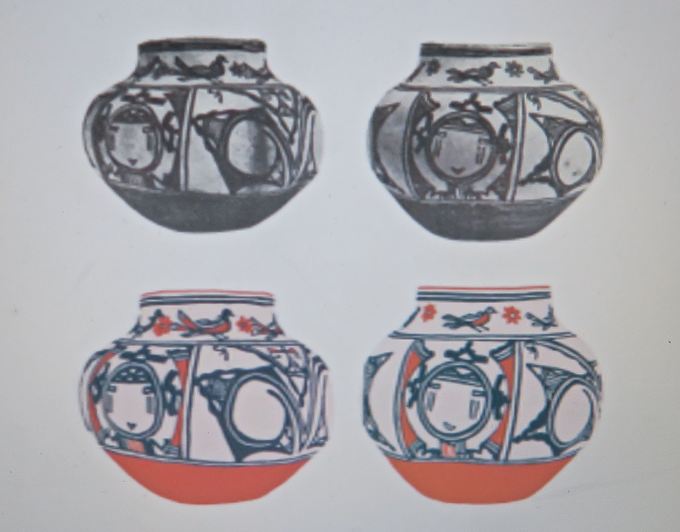
The second part of the Opinion is more complex.  It involves 41 illustrations created from designs visible in the black and white photographs of pottery that were published in the book Historic Hopi Ceramics (HHC).  Below is a comparison of two of the black and white photographs and the illustrations created from them.


First Judge Brack determined that, unlike the photograph of the Tusayan or Kayenta jar discussed above that is not copyrightable, the black and white photographs in HHC show "a minimal degree of creativity--if only a humble spark".  Decisions were made to photograph each ceramic in the same way and to strip the backgrounds from each of the individual photographs "to emphasize the impact of the collection as a whole rather than the intricacies of each individual piece."  However, just because a photograph is copyrightable does not mean that "every element of the work is protected....the less original the plaintiff's work, the more the defendant must copy to infringe on the plaintiff's copyright."

Importantly. Judge Brack finds that the Native American designs on the pottery and the form of the pottery are not copyrightable elements of Harvard's photographs: "Here the copyright of Historic Hopi Ceramics does not protect against copying the most prominent features in the works: the intricate pottery designs and forms achieved by a Hopi potter, perhaps Nampeyo." (emphasis added). 

Judge Brack notes that the protection of the HHC photographs is "incredibly limited" and only a verbatim copy would violate a copyright with such a small amount of creative input from the photographer.  He observes that Mr. Elmore's illustrations highlight the designs, which are non-copyrightable elements, and switch the emphasis from the condition of the pots as a whole collection to these design elements.  The illustrations use line art and are in color.  They clean up and bring out elements of the designs, while eliminating aspects of the pottery itself, such as fire clouds.  Judge Brack writes: "Considering only the  protected elements in the Historic Hopi Ceramics photographs and Mr. Elmore's images, reasonable minds could not find substantial similarity between the two." 

He also notes that Mr. Elmore picked individual ceramics to use in his illustrations and did his own arrangements of them, in order to emphasize comparison of the designs.  Mr. Elmore's use of these ceramics to establish a novel thesis would give his work protection under the fair use doctrine.

I have to wonder why Harvard brought this copyright infringement suit against Mr. Elmore in the first place.  His use of illustrations of designs seen in photographs is quite common in ethnology and archaeology publications and is a long standing practice.  Illustrations done from photographs of pottery in a museum are used, for instance, in Symbols in Clay, a 2010 publication from the Peabody Museum Press.  Why is The Peabody Museum Press at Harvard suing Mr. Elmore for doing the exact same thing that they did in a recent publication?  Why didn't the editor, Joan O'Donnell, consider this before pursuing this charge?  Why didn't the Peabody Museum Director, Jeff Quilter, point out this obvious fact before a lawsuit was filed?  Why didn't Harvard's legal counsel do even the most cursory inquiry about the use of illustrations of pottery designs in publications before filing this suit?

Perhaps some sense of this can be made by looking to Harvard's expert witness report. On page 5 of his disclosure, Thomas Chavez, retired director of the Palace of the Governors in Santa Fe, New Mexico, writes that museums often charge fees for the use of their copyrighted photographs, and indeed, the Peabody Museum at Harvard charges such fees and they constitute one of their revenue streams.  It is possible that the Peabody Museum was eager to extend the reach of its copyrights, thus enlarging the number of photographs that could generate income for the museum.  It is also possible that this copyright infringement charge was frivolous and/or vindictive in its motives.  If this is true, then neither the facts of the case nor the law were important elements in the decision to bring the charges.

Mr. Elmore is grateful that this ruling found him innocent of copyright violation charges and that the Native American designs he used in his book are still freely available to all, but especially to the Hopi/Tewa potters who consider them such an important part of their cultural heritage.

Mr. Elmore would like to thank his attorneys, Christopher DeLara and Jonathan Garcia of the Guebert Bruckner law firm in Albuquerque, New Mexico for their hard work, clear thinking, and fine writing in pleading this matter before the court.

Opinion and Order MSJ


 This is the fourth in a series of blogs about In Search of Nampeyo and Harvard's lawsuit against Steve Elmore. Future essays will deal with the contracts and abuse of the legal system.


Creative Commons License BY NC ND


Wednesday, April 27, 2016

Why is Harvard Claiming Copyright to Native American Designs?

This is the first post for the FreeNampeyo blog.  

How In Search of Nampeyo came to be written

Steve Elmore is an Indian Trader and owner of Steve Elmore Indian Art in Santa Fe, New Mexico.  He has been studying Hopi pottery for over twenty years and works closely with contemporary Hopi potters. Events were set in motion when Steven LeBlanc, then Director of Collections at the Peabody Museum of Archaeology and Ethnology at Harvard University asked  Mr. Elmore to write a book for the Peabody Museum Press on his discovery that many of the ceramics in their Keam collection were the work of the great Hopi potter Nampeyo, and not a random assortment of pottery made by hundreds of different potters, as previously thought.  
Steve wrote the book and submitted it, eventually receiving three reviews, which he was asked to respond to.  He was then asked by the press to do a major revision of the book for the more scholarly “Papers” series, rather than the “Collections” series he had originally written for.  Six months later, he submitted this second version.  The manuscript was rejected.   A Formal Notification letter from the board returned to him “all rights” in all versions of the manuscript.  The letter recommended that he publish elsewhere and made some suggestions as to other publishing venues.  

Relying on this letter, and double checking with several intellectual property attorneys, Steve decided to self publish the book, as it had already been through many reviews and was essentially finished.  He published In Search of Nampeyo: The Early Years 1875 - 1892 in 2015.  In Search of Nampeyo  has won four national book awards, including awards for best art book and best interior design.  It has received many positive reviews. 
However, Harvard was displeased and sued him for breach of contract, copyright infringement, and false designation.  Steve countersued on a number of charges including bad faith, interference with business, and conspiracy to steal intellectual property.   Right now, the book is under a temporary injunction as Harvard has persuaded a judge that the book has caused them “irreparable harm”. 
Harvard's Copyright Infringement Claims
The rest of this post will look into the copyright issues that are raised by Harvard's lawsuit.  I will give the context and try to summarize the main issues.  
The Keam collection was purchased by Mary Hemenway in 1892 and after she died, donated to Harvard in 1894.  It was unpacked about 85 years later, and In 1980 Harvard published a book called Historic Hopi Ceramics (HHC) containing simple black and white photographs of the ceramics; it is a catalog of the collection.  In the manuscript that Steve submitted to Harvard were some photos cut from HHC  which he intended as place holders for future photography.  After the manuscript was rejected, he hired a designer to do three color, hand drawn, illustrations of the designs on these pieces of pottery and included these in his book.  These illustrations are the subject of Harvard's copyright infringement suit.  Harvard did not make any of the pottery and all these pieces of pottery were made before 1892 when the collection was purchased, so all would be considered in the public domain.  Harvard's argument is that since they photographed the pottery, no one can make copies of the designs depicted in their photographs.
In Hopi culture, designs are passed down in families.  Nampeyo taught her daughters to make pots and passed her designs to them and these designs have now been passed down and are in use by the fourth and fifth generations.  Nampeyo family potters consider the designs to belong to them and/or to their culture.  Despite Harvard's statements to the contrary, if the court rules in their favor, Harvard would in fact own not just the copyright to their photographs, but to the designs themselves. 
Steve did not use their photographs, nor did he make exact copies of their photographs.  The illustrations leave out all details of the pottery itself such as shadows, chips, cracks, uneven paint and slip, and fire clouds.  They also idealize the design, adding elements not visible in the photographs.  It is the designs that are the subject of the text and shown in the illustrations.  While it is true that the designer did use the photographs from HHC to create his designs, he also used additional sources in order to see the details of the designs and colors. 
Harvard claims that its catalog shots have sufficient creativity to be copyrighted as original works in their own right.  In particular, Harvard points to the choice of angle as original, because other angles could have been chosen.  Here is Harvard's strongest example.  They invoke the "reasonable person" standard.  The illustration should be considered a violation of their copyright if a reasonable person, without specifically searching for differences, would regard the two images as identical.

comparison.jpg

The big question here is where a line is to be drawn.  A clear case would be one in which a photographer used a Hopi pot as part of a photograph meant to be a piece of art in its own right.  If this photographer put the Hopi pot on white velvet, lit it with purple light, and surrounded it with apples, no one else could use the same set-up and take that same image without violating this photographer's copyright as the creative elements of background, lighting, and setting were clearly chosen as artistic decisions.  However, the fact that a Hopi pot was included in the photograph certainly does not give the photographer ownership of the design on that pot.  Court decisions have often relied on the technique of first filtering out public domain portions of the photograph, and judging copyright claims on the basis of the remaining elements.  On the other end of the spectrum is a verbatim copy.  If Harvard's own photograph was simply reproduced in Steve's book, this might be considered a copyright violation.
I say might be considered a copyright violation because the issue of fair use must be considered.  Since Mr. Elmore picked out a small number of pots from the entire Keam collection to use in a scholarly argument establishing Nampeyo as the artist who made these pots, the use he made of HHC should be considered transformative of the original work and serving the purpose that the fair use doctrine was established for, furthering the development and presentation of new knowledge.  He did not use the "heart" of HHC, which is simply a catalog and he did not decrease the value of the original book.  In fact HHC has increased in value since Steve published In Search of Nampeyo.
I have now read rather broadly on the subjects of copyright and fair use.  I do not think that Harvard has a legitimate case against In Search of Nampeyo, and I certainly don't think that Harvard has any right to Native American designs.  Those with the desire to read the pleadings will see that the lawyers for the two sides have very different approaches to the presentation of evidence and that the rhetorical strategies are especially different.  These differences, to my relatively inexperienced eye, often seem to influence a judge's rulings, seemingly looming larger than the law and the facts of the case.
The contract case is related, but separate.  Since the images were in the manuscript that Harvard returned to Steve with "all rights", the letter appears to have granted him the right to reproduce Harvard's photographs if he chose.
 If you want to read the court documents associated with the copyright, they are linked below.  Steve's lawyers filed a Motion For partial Summary Judgement, asking the judge to review the facts and the law and rule on just this aspect of the case.  Harvard's lawyer filed a response and also his own motion for a summary judgement for another photograph, and then Steve's lawyer filed a reply to the response and a reply in opposition to Harvard's new charge. 
And, for fun, a song imagining what would happen if Steve Elmore really did have to power to cause "irreparable harm" to Harvard:  Dude, Where's Harvard


Creative Commons License BY NC ND